When shopping for speakers, whether for your home audio setup, car, or professional sound system, you’re likely to encounter terms like “wattage,” “power handling,” and “RMS.” These specifications can be confusing for beginners and even intermediate audio enthusiasts. Understanding what wattage means for speakers is crucial in making an informed purchase that matches your needs and prevents equipment damage.
In this article, we’ll break down the concept of wattage in speakers, why it matters, how it affects sound quality and volume, and how to choose the right wattage for your audio setup.
Understanding Wattage in Speakers: The Basics
Wattage is a measure of electrical power and, in the context of speakers, it indicates how much power a speaker can handle or requires to operate efficiently. But wattage isn’t just a simple number—it involves nuances that impact your audio experience.
What is Wattage?
- Watt (W) is a unit of power, defined as one joule per second.
- For speakers, wattage often refers to how much electrical power the speaker can safely receive from an amplifier without being damaged.
- Wattage can also describe the output power of an amplifier feeding the speaker.
RMS vs Peak Wattage
When evaluating speaker wattage, you’ll often see two terms: RMS (Root Mean Square) and Peak Power.
- RMS Wattage: This is the continuous power a speaker can handle or produce over time without damage. It’s the more reliable and useful measurement to consider.
- Peak Wattage: The maximum power the speaker can handle in short bursts without distortion or damage. Peak wattage is usually higher than RMS but less relevant for everyday use.
Why Does Wattage Matter?
Wattage affects:
- Volume: Higher wattage speakers or amplifiers can produce louder sound.
- Sound Quality: Insufficient wattage can lead to distortion, while too much can damage the speaker.
- Durability: Matching wattage correctly ensures your speakers last longer.
How Wattage Impacts Speaker Performance
Many buyers equate higher wattage with better speakers, but it’s not that simple. Wattage plays a role in several performance aspects:
Volume and Loudness
- Wattage is closely related to volume, but the relationship isn’t linear.
- Doubling the wattage doesn’t double the loudness; it increases loudness by about 3 decibels (dB).
- Human ears perceive a 10 dB increase as roughly twice as loud, which requires about ten times the wattage.
Sound Clarity and Distortion
- Using an amplifier that supplies less wattage than a speaker’s RMS rating can cause the amp to clip.
- Clipping introduces distortion, damaging sound quality and potentially harming your speakers.
- Conversely, overpowering a speaker beyond its peak wattage risks physical damage to the driver components.
Speaker Efficiency and Sensitivity
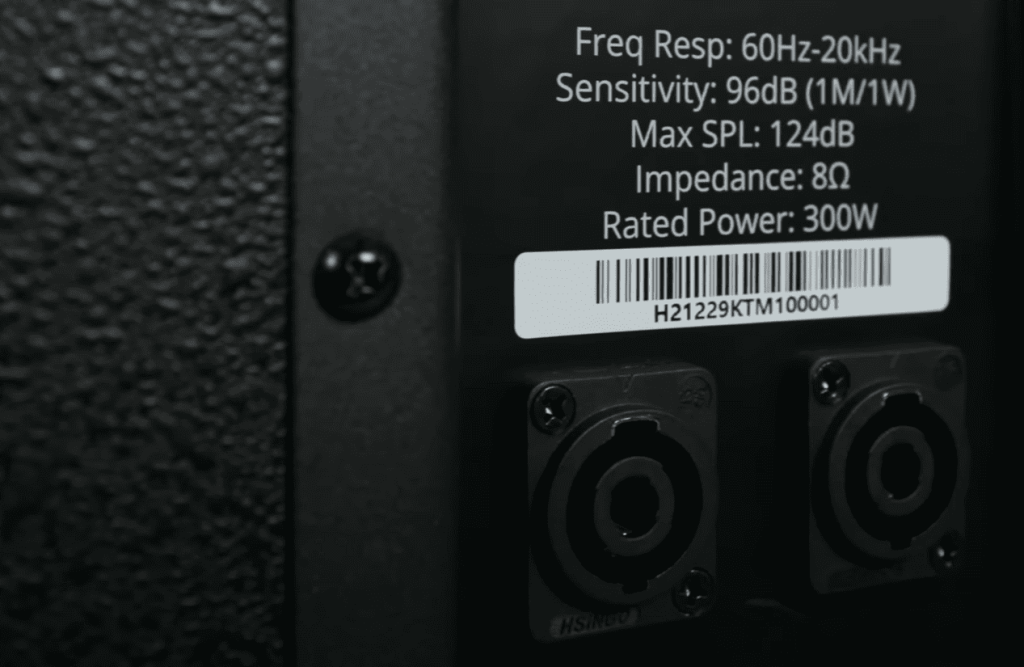
- A speaker’s sensitivity rating (measured in dB) tells you how loud it will be at 1 watt/1 meter.
- More efficient speakers require less wattage to achieve higher volumes.
- This means a lower wattage speaker with high sensitivity can outperform a high wattage, low sensitivity speaker.
Matching Wattage: Speakers and Amplifiers
One of the biggest challenges in audio setups is ensuring your amplifier and speakers are compatible in terms of wattage.
Why Matching Wattage is Crucial
- If your amplifier’s power output is much higher than your speaker’s RMS rating, you risk blowing the speakers.
- If the amplifier’s output is too low, you risk distortion due to clipping when turning up the volume.
Guidelines for Matching Wattage
- Aim for an amplifier power output that is equal to or slightly higher than your speaker’s RMS rating.
- This balance allows clean sound reproduction without risking speaker damage.
- For example, if a speaker has an RMS rating of 100 watts, an amplifier with an output of 100 to 150 watts per channel is ideal.
Understanding Speaker Impedance and Its Role
- Speaker impedance, measured in ohms (Ω), also affects wattage delivery.
- Amplifiers provide varying power outputs depending on the speaker impedance.
- Typical speaker impedances are 4, 6, or 8 ohms, with 8 ohms being the most common for home speakers.
- Always check that the amplifier can handle your speaker’s impedance to ensure proper wattage delivery.
What Wattage Should You Look For?
Choosing the right wattage depends on your specific use case, environment, and listening habits.
For Home Audio Systems
- Typical home speakers have RMS ratings between 20 and 200 watts.
- For small rooms and casual listening, 20-50 watts RMS per channel is usually sufficient.
- For larger rooms or higher volumes, look for speakers rated 100 watts or more.
For Car Audio
- Car speakers often range from 25 to 100 watts RMS.
- Subwoofers usually require higher wattage, sometimes 300 watts RMS or more.
- Amplifier power should closely match the speaker’s RMS rating.
For Professional or PA Systems
- Professional speakers often have very high RMS wattage ratings (hundreds to thousands of watts).
- They require powerful amplifiers and specialized setups.
- Correct wattage matching is critical to avoid equipment damage in live sound environments.
Common Misconceptions About Speaker Wattage
More Watts Always Means Better Sound
Not necessarily. Higher wattage can allow louder volume but doesn’t guarantee sound quality. Speaker design, materials, and sensitivity often matter more.
Peak Wattage Is What You Should Focus On
Peak wattage is mostly marketing hype. RMS wattage is a more accurate representation of a speaker’s capability.
You Need an Amplifier With Equal Wattage to Your Speakers
A slightly more powerful amplifier than your speaker’s RMS rating is safer and helps avoid distortion, but an amplifier with too high output must be used carefully.
How to Safely Use Wattage for Optimal Speaker Performance
Tips to Prevent Speaker Damage
- Avoid constantly running speakers at maximum volume.
- Use amplifiers matched to speaker RMS ratings.
- Monitor for distortion or clipping and reduce volume if you notice it.
- Consider using a quality amplifier with built-in protection features.
Enhancing Your Audio Setup
- Use a subwoofer for deep bass instead of pushing main speakers beyond wattage limits.
- Room acoustics can affect perceived loudness; improve room treatment for better sound.
- Regular maintenance and inspection help ensure long-lasting speaker performance.
FAQ
Can I use a lower wattage amplifier with a high wattage speaker?
Yes, you can, but it’s important to be cautious. Using an amplifier with less power than your speaker’s RMS rating may cause the amplifier to work harder, leading to distortion known as clipping. This distortion can damage your speakers over time. To avoid this, try to match or slightly exceed your speaker’s RMS wattage with your amplifier.
Does higher wattage always mean louder sound?
Not necessarily. While higher wattage allows for higher potential volume, loudness also depends on speaker sensitivity and efficiency. A speaker with high sensitivity can sound louder at lower wattage compared to a less sensitive speaker with more watts. The room size and acoustics also play a big role in perceived loudness.
What happens if I overpower my speakers with too much wattage?
If you supply more power than a speaker’s peak wattage, you risk damaging the speaker’s components such as the voice coil or cone. This can cause permanent damage, distortion, or even complete failure. Always ensure your amplifier’s output is within the speaker’s recommended wattage range.
How can I tell if my speaker is being damaged due to wattage issues?
Signs of damage from wattage problems include distorted or crackling sounds, rattling, or a sudden drop in audio quality. If you notice these symptoms, lower the volume immediately and check your amplifier-speaker compatibility to prevent further damage.
What’s the difference between RMS and peak wattage?
RMS (Root Mean Square) wattage refers to the continuous power a speaker can handle safely over time without damage. Peak wattage is the maximum power a speaker can handle in short bursts. RMS is the more reliable and important figure to consider when matching speakers and amplifiers.
Is it better to have an amplifier with more wattage than the speaker’s rating?
Yes, having an amplifier with a slightly higher wattage than your speaker’s RMS rating is generally safer. It allows the amplifier to run cleanly without distortion at higher volumes. However, be cautious not to push the volume to the point where the speaker is being overdriven beyond its limits.
How does speaker impedance affect wattage?
Speaker impedance (measured in ohms) influences how much power an amplifier delivers. Amplifiers provide different wattage outputs depending on the speaker impedance. Make sure your amplifier can handle the impedance of your speakers to ensure proper power delivery and avoid damage.